इवेंट रिपोर्ट
The Enchanting History of Crystal Balls
In 1582, John Dee (1527–1609)—a mathematician, astrologer, occult philosopher, and antiquarian—reported that an angel named Uriel had given him a magical crystal. This faintly violet quartz sphere, set in a rough silver mounting, eventually passed to his son Arthur Dee (1597–1651), who later handed it on to the physician and alchemist Nicholas Culpepper (1616–1654).
Ava Reynolds
रिपोर्टर
डेस्क नोट
नीचे आयोजन की पूरी रिपोर्ट और महत्वपूर्ण अपडेट पढ़ें।
डेस्क
ग्लोबल इवेंट
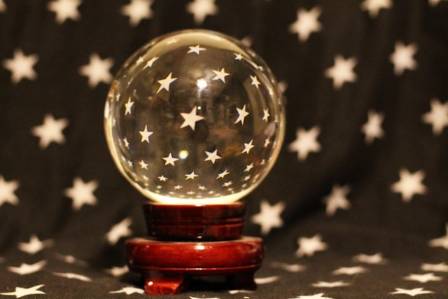
In 1582, John Dee (1527–1609)—a mathematician, astrologer, occult philosopher, and antiquarian—reported that an angel named Uriel had given him a magical crystal. This faintly violet quartz sphere, set in a rough silver mounting, eventually passed to his son Arthur Dee (1597–1651), who later handed it on to the physician and alchemist Nicholas Culpepper (1616–1654).
Culpepper reportedly used the stone for healing practices until 1651, when a malicious spirit allegedly erupted from it and terrified him almost to death. Today, this same crystal is preserved in the Science Museum, though curators humorously note that any supposed spirit has long since vanished. Dee owned other mystical stones as well, including one now identified as an Aztec obsidian mirror housed in the British Museum.
The idea that crystals possess prophetic or protective powers has deep historical roots and was widely accepted across different social classes. Such objects—like ritual circles, dreams, or visions—were believed to blur the boundary between the physical world and the spiritual realm. Queen Elizabeth I herself was persuaded by Dee to gaze into a crystal, while others used “crystalline vessels” (as Dee described them) as cures for both human and animal ailments. Certain stones were also used for divination, particularly to locate missing money, hidden treasures, or lost individuals. It was believed that benevolent spirits could inhabit crystals to communicate with humans; during Elizabeth’s reign, for instance, a spirit known as “Oryance” was summoned through a crystal to help recover lost coins.
A historical illustration from the early 1500s shows two crystal spheres intensifying sunlight into flame-like effects in a depiction of the Martyrdom of Saint Blaise, preserved in the British Library.
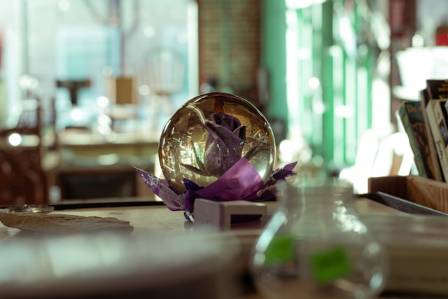
The idea that rock crystal held supernatural qualities can be traced back to antiquity. The Roman writer Pliny the Elder theorized that quartz was formed from water frozen so intensely that it became permanently solid, reinforcing its mystical associations with icy mountain origins. Pliny also believed crystal could serve practical purposes such as cauterizing wounds by concentrating sunlight, generating heat from a substance that otherwise appeared cold and inert.
Archaeological evidence shows that crystal spheres were used across Iron Age and Viking Europe, often buried as grave goods. Some were mounted in copper or silver, while an especially rare example set in gold is preserved in the Metropolitan Museum of Art and dates to the Hunnic period (4th–5th century). Another was discovered in the burial of Queen Wisigard of the Merovingian era around 540 CE. Earlier examples appear to have been associated with pre-Christian healers or ritual practitioners, while later ones were sometimes placed in children’s graves as protective objects for the afterlife journey. Some crystals were fitted with loops or mounts suggesting they were worn as pendants, indicating that ownership of such objects was likely restricted to elites and served as symbols of power and status. Even royal regalia, such as the Scottish sceptre, incorporates a crystal orb at its apex.
A surviving crystal orb mounted in silver, decorated with stylized floral motifs and enclosed in a fitted wooden and shagreen case, dates to around 1620 and demonstrates the refined craftsmanship used in such objects.
There is also a tradition suggesting that some crystal spheres were brought back from the Holy Land during the Crusades. If accurate, this would mean that these objects were not only associated with pagan practices but were also reinterpreted within Christian symbolism, representing the universe as a divine creation. This idea appears in Renaissance art, notably in Leonardo da Vinci’s Salvator Mundi (c.1500), where Christ holds a crystal orb symbolizing the world under his protection.
Close-up details from Leonardo’s painting emphasize the translucent sphere, reinforcing its association with cosmic order and spiritual meaning.
Even today, clear quartz retains its reputation for unusual physical sensations, such as an enduring coolness to the touch. Some observers claim it produces subtle physical or emotional reactions when held, further contributing to its mystical reputation. Because of these perceived properties, crystal spheres are often polished into perfect orbs, used in practices such as scrying or crystallomancy, where practitioners attempt to see visions or insights within them. Others value them simply for their aesthetic beauty and enigmatic qualities. Although scientific support for such beliefs is limited, cultural fascination with crystal gazing remains strong, appearing in modern spiritual practices and New Age healing traditions, as well as in historical settings like fortune-telling booths.
A typical crystal ball mount consists of metal bands secured at opposite ends of the sphere rather than soldered, since heat would damage the crystal. These fittings are often decorated with geometric patterns such as zigzags or chevrons, possibly symbolizing water. Some traditions hold that water exposed to a crystal’s influence becomes infused with healing properties and is then consumed or used in rituals, especially if collected from sacred or “fairy” wells.
Throughout history, crystal spheres were highly valued and often treated as heirlooms believed to carry healing or protective power. They were sometimes loaned out under strict conditions, and people were known to travel great distances to touch a renowned stone. Their significance was especially strong in Scotland, where such objects were sometimes carried into battle for protection or victory.
Across time and cultures, crystal balls have accumulated layered meanings drawn from religion, folklore, medicine, and symbolism. Even in the modern world, despite scientific skepticism, belief in their mystical qualities has not completely disappeared.

संबंधित अपडेट

· en
Easy Ways to Cook Oysters
Rowan Clarke

· hi
टॉप रग्बी टिप्स: मैदान पर अपने कौशल को बढ़ाना
फिन थॉन्सन

· en
Dressed Up Avocados
Abigail Morgan

· hi
वैगन पार्टी: 2025 BMW M5 टूरिंग बनाम ऑडी RS6 अवंत परफॉर्मेंस!
प्रतीक
· en
Essential Guide to Acquiring Designer Fashion Jewelry
Barry Southwick

· en
How to Build a Snow Cave
Julian Cavendish