
When you ask an AI a question and it gives you a confident, detailed answer that sounds completely plausible—but is actually wrong—you have just witnessed an AI hallucination. It is one of the most important concepts for anyone using AI tools to understand, yet it remains widely misunderstood.
This guide explains, in plain language, what AI hallucinations are, why they happen, and what you can do about them.
What Is an AI Hallucination?
An AI hallucination occurs when a large language model (LLM) generates information that sounds confident and coherent but is factually incorrect, fabricated, or not supported by its training data. The AI does not “mean to lie”—it genuinely cannot tell the difference between what it learned during training and what it is making up in the moment.
The key word here is “confident.” Unlike a human expert who might say “I am not sure,” an LLM has no built-in uncertainty signal. It generates the next most likely token based on patterns in its training data, and it does so with the same fluency whether the output is true or false.
A Simple Analogy
Think of an LLM as an extremely advanced autocomplete system. When you type the first few words of a sentence into your phone, it suggests the most likely next word. An LLM does the same thing—but at scale. It predicts not just the next word, but the next sentence, paragraph, and entire article.
Just as your phone’s autocomplete sometimes suggests something awkward or irrelevant, an LLM can “suggest” a fact that no human ever said, a book that was never written, or a study that never happened. The difference is that your phone’s suggestion is obviously silly. An LLM’s hallucination can sound deeply authoritative.
Why Do AI Hallucinations Happen?
Understanding the root causes helps you use AI more effectively.
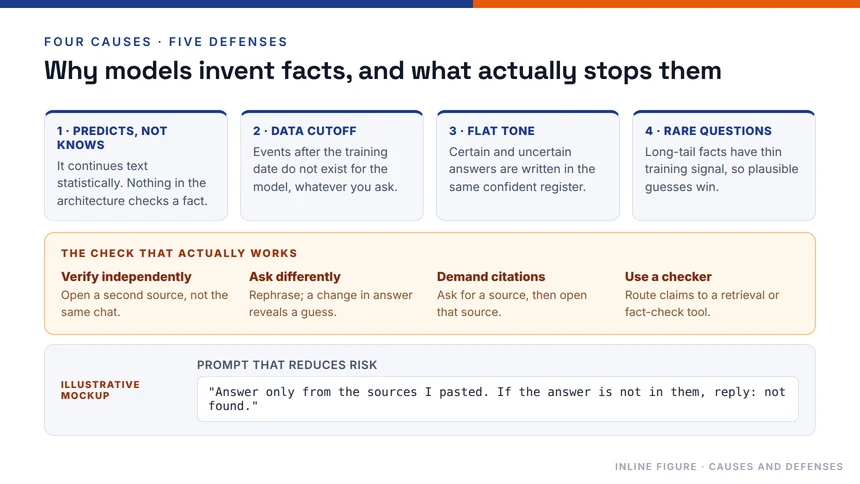
1. LLMs Predict Words, Not Facts
At their core, large language models are prediction engines. They were trained on enormous datasets—billions of webpages, books, and documents—and learned to predict what word most likely comes next in any given sequence.
When you ask “Who was the first person to walk on the moon?” the model does not “look up” the answer in a database. It generates the most statistically probable continuation based on patterns it has seen before. If “Neil Armstrong” appeared next to those words billions of times during training, it will output “Neil Armstrong”—correctly.
But if a similar question never appeared in training, or if the phrasing was unusual, the model falls back on predicting plausible-sounding tokens that may not correspond to real facts.
2. Training Data Has a Cutoff Date
Every LLM has a knowledge cutoff. It simply does not know events, discoveries, or developments that occurred after its training data was collected. Yet when asked about post-cutoff topics, it often generates fluent responses rather than saying “I do not know.”
This is not deception. It is a limitation of how the model was designed. The model has no native ability to distinguish between pre-cutoff knowledge and guesses about post-cutoff reality.
3. Confident Tone Is Baked In
LLMs are optimized to generate text that sounds natural and human-like. Part of sounding human means being fluent and confident. There is no built-in flag that says “this answer is uncertain—add a caveat.” The model will produce the same level of confidence whether it is reciting well-established facts or generating something it invented on the spot.
This is why a hallucinated answer can feel more convincing than a correct one. The hallucinated answer is often more fluent, more detailed, and more assertive.
4. Ambiguous or Rare Questions
When you ask about a common topic, the model has seen countless similar queries during training and can draw on strong patterns. When you ask about something obscure, niche, or highly specific, the model has fewer reliable patterns to draw on. It is more likely to improvise—and improvise confidently.
Real-World Examples of AI Hallucinations
Hallucinations are not rare edge cases. They happen regularly, even in commercial products:
- A lawyer used ChatGPT to draft a court brief and submitted six fake case citations. The cases did not exist.
- A travel AI generated a detailed review of a restaurant that had closed years earlier, including a menu and hours of operation that were entirely fabricated.
- An AI medical assistant suggested a plausible-sounding but completely invented drug interaction.
These are not failures of a specific tool—they are structural properties of how LLMs work.
How to Protect Yourself from AI Hallucinations
Understanding why hallucinations happen is the first step. Here is how to practically reduce their impact.
1. Verify with Independent Sources
Always cross-check factual claims—especially names, dates, statistics, and citations—against independent sources. If an AI cites a study, look up the study directly. If it names a person, confirm with a reliable reference.
2. Ask the Same Question Differently
Rephrase your question and ask again. If the AI gives different answers, that is a signal that one or both responses may be unreliable.
3. Be Specific About Uncertainty
Instead of asking “Tell me about X,” try “What do you know for certain about X? Where does your knowledge end?” Explicitly prompting the model to acknowledge uncertainty can reduce confident fabrications.
4. Use Fact-Checking Tools
Tools like Perplexity and Gemini with deep research modes can browse the web in real time and cite their sources. These are not immune to errors, but they significantly reduce the hallucination problem because they anchor answers in retrieved documents rather than pure prediction.
5. Understand the Limits of Each Tool
Not every AI tool is designed for the same task. A model optimized for creative writing will generate confident-sounding fiction freely. A tool designed for research will have guardrails to reduce fabrication. Choose the right tool for the job.
The Bottom Line
AI hallucinations are not bugs that will someday be “fixed.” They are a fundamental consequence of how LLMs work—predicting likely text rather than retrieving verified facts. Every major AI company is actively working to reduce hallucination rates, but the underlying architecture makes them nearly impossible to eliminate completely.
The practical solution is not to wait for perfect AI. It is to develop good habits: verify, cross-check, and maintain human judgment. The best AI users are not the ones who trust the technology most—they are the ones who understand its limitations best.
Understanding hallucinations is one of the most important AI literacy skills you can build. Now that you know why they happen, you are already better equipped to use AI tools safely and effectively.