इवेंट रिपोर्ट
Auroras: The Northern and Southern Lights
Have you ever witnessed the breathtaking, colorful lights moving across the night sky? The nearer you travel toward the Earth’s polar regions, the higher your chances become of experiencing this incredible natural phenomenon. In the Northern Hemisphere, this display is known as the aurora borealis, or the northern lights. In the Southern Hemisphere, it is called the aurora australis, or the southern lights.
Eleanor Montrose
रिपोर्टर
डेस्क नोट
नीचे आयोजन की पूरी रिपोर्ट और महत्वपूर्ण अपडेट पढ़ें।
डेस्क
ग्लोबल इवेंट
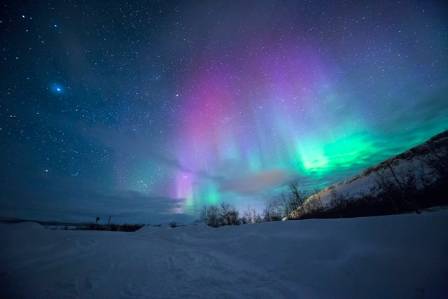
Have you ever witnessed the breathtaking, colorful lights moving across the night sky? The nearer you travel toward the Earth’s polar regions, the higher your chances become of experiencing this incredible natural phenomenon. In the Northern Hemisphere, this display is known as the aurora borealis, or the northern lights. In the Southern Hemisphere, it is called the aurora australis, or the southern lights.
The aurora appears as glowing waves and ribbons of light stretching across the upper atmosphere, creating one of the most spectacular sights visible from Earth. Astronauts aboard the International Space Station have also captured stunning views of the southern lights from space.
What Creates the Aurora?
Auroras are created through a powerful connection between the Sun and Earth’s atmosphere. The Sun constantly releases solar wind, a stream of extremely hot plasma containing electrons, protons, and other charged particles. Every second, this solar wind carries roughly one million tons of material away from the Sun.
Earth is protected by its magnetosphere, a large magnetic shield that surrounds the planet and blocks most of the incoming solar wind. However, during periods of intense solar activity, such as solar flares or coronal mass ejections, huge amounts of charged particles are launched into space at high speeds.
When these energetic particles reach Earth, they interact with the planet’s magnetic field. Some particles are guided along magnetic field lines toward the North and South Poles, where they enter the atmosphere. As these particles collide with gases in the atmosphere, they transfer energy to atoms and molecules. When these gases release the stored energy, they produce the glowing colors that form the aurora.
Why Do Auroras Have Different Colors?
The colors of auroras are created by interactions between solar particles and different gases in Earth’s upper atmosphere, especially oxygen and nitrogen. Each gas produces different colors depending on the altitude and type of interaction.
Oxygen atoms can create green and red displays, while nitrogen produces blue and reddish-purple shades. Green auroras are the most commonly seen because they occur when solar particles interact with oxygen at lower altitudes, usually between 100 and 300 kilometers (62 to 180 miles) above Earth’s surface.
Red auroras are much rarer and occur at higher elevations, generally above 300 kilometers (180 miles), where oxygen atoms release red light. These unusual displays often appear during especially powerful solar storms.
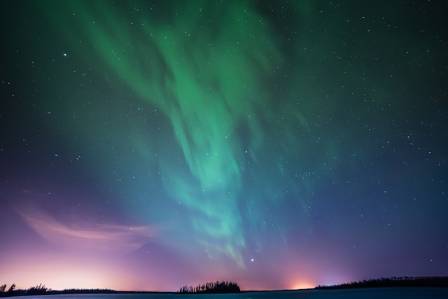
Do Auroras Influence Earth?
Throughout history, auroras have fascinated people and inspired countless stories, observations, and scientific studies. For most of the time, they are simply a beautiful natural event and do not directly affect life on Earth.
However, strong solar activity that creates intense auroras can sometimes interfere with radio communication systems. When disturbances in Earth’s magnetic field become especially powerful, auroras may appear much farther away from the polar regions and become visible in areas closer to the middle latitudes.
Auroras Exist on Other Planets Too
Earth is not the only world where auroras occur. Any planet that has both an atmosphere and a magnetic field has the potential to produce these glowing displays.
Scientists have observed impressive auroras on other planets, including Jupiter and Saturn. These planetary light shows are created through similar interactions between solar particles, magnetic fields, and atmospheric gases, revealing that auroras are a fascinating feature of many worlds beyond our own.
संबंधित अपडेट

· hi
शीर्ष 6: क्लासिक कूप
पार्थ

· hi
हैमबर्गर के आश्चर्यजनक स्वास्थ्य लाभ
गौरव
· en
The Most Insanely Beautiful Coastlines in the World
Margaret Delacroix

· hi
दुनिया में सबसे अच्छा सूर्यास्त 2024/2025 कहाँ मिलेगा
कनक
· hi
क्या एक पूर्णिमा वास्तव में हमारे व्यवहार को प्रभावित करती है?
लो स्टाइक्स
· hi
सबसे ऊंची इमारतें
यश