इवेंट रिपोर्ट
Lunar Rovers & Surface Vehicles
Since the dawn of space exploration, rovers have played a crucial role in helping humanity study the Moon’s surface. From the first crewed vehicles that carried astronauts across the lunar landscape to sophisticated robotic explorers controlled from Earth, lunar rovers have dramatically expanded our ability to investigate regions beyond the reach of human footsteps.
Adam Wilson
रिपोर्टर
डेस्क नोट
नीचे आयोजन की पूरी रिपोर्ट और महत्वपूर्ण अपडेट पढ़ें।
डेस्क
ग्लोबल इवेंट
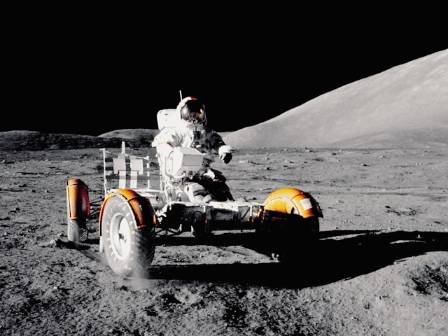
Apollo Lunar Roving Vehicle (LRV)
The Apollo Lunar Roving Vehicle, commonly known as the LRV, was used during the Apollo 15, Apollo 16, and Apollo 17 missions between 1971 and 1972. Designed as an electric-powered four-wheel rover, it enabled astronauts to travel much farther across the Moon’s surface than would have been possible on foot.
Developed by Boeing together with General Motors’ Delco Electronics division, the rover had a mass of approximately 210 kilograms. Despite its relatively lightweight structure, it was capable of transporting up to 490 kilograms of astronauts, scientific instruments, and lunar samples thanks to the Moon’s low gravity. The vehicle could reach speeds of about 18 kilometers per hour. During the Apollo 17 mission, the LRV achieved a cumulative travel distance of 35.9 kilometers, setting a lunar exploration record for crewed missions.
Lunokhod 1 and Lunokhod 2 (Soviet Union)
The Soviet Union pioneered robotic lunar exploration with the Lunokhod program, producing the first remotely operated rovers to successfully travel across the Moon.
Launched in 1970, Lunokhod 1 operated for nearly eleven months and covered approximately 10.5 kilometers of lunar terrain. Its successor, Lunokhod 2, arrived in 1973 and significantly expanded the achievement by traveling around 42 kilometers.
Both rovers were controlled from Earth, requiring operators to account for a communication delay of roughly 2.5 seconds. Lunokhod 2’s distance record remained unbeaten for more than four decades and was eventually surpassed by the Mars rover Opportunity in 2014.
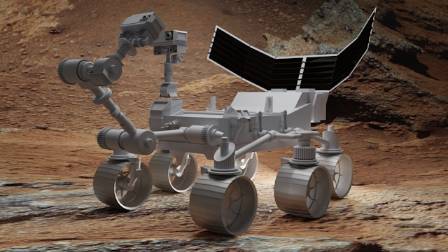
Yutu and Yutu-2 (China)
China entered lunar rover exploration with Yutu, which was delivered to the Moon by the Chang’e 3 mission in December 2013.
Yutu successfully traveled about 114 meters before experiencing a mechanical malfunction that prevented further movement. Although immobilized, the rover continued conducting scientific observations as a stationary platform for several months.
Its successor, Yutu-2, arrived on the Moon’s far side aboard the Chang’e 4 mission in January 2019. The rover has traveled more than 1,500 meters and continues to operate, making it the longest-running lunar rover in history.
Rashid (United Arab Emirates)
Rashid was the first lunar rover developed by the United Arab Emirates. The compact rover, weighing around 10 kilograms, was transported aboard the Japanese HAKUTO-R lunar lander operated by ispace.
During the mission’s landing attempt in April 2023, the spacecraft lost contact and crashed before reaching the lunar surface. As a result, the Rashid rover was destroyed before it could begin operations.
Despite the setback, the UAE has announced plans for a successor mission featuring the next-generation rover, Rashid 2, which is expected to continue the nation’s lunar exploration efforts.
संबंधित अपडेट

· en
Where Are Puffins Found?
Celine Whitaker

· en
LED Technology Illuminates Cities: 20 Iconic Displays Worldwide
Vicky

· en
Best Full-Size Luxury Sedans to Buy Now
Sophia Ellis

· en
The 10 Most Renowned Painters in History
Rosa
· hi
गहरे समुद्र के अजूबे: समुद्री जीवन की मिट्टी की मूर्तियाँ बनाना
किरण चावला

· hi
सर्दियों में घूमने के लिए सबसे अच्छे शहर
इला